 Italiano
  English
  Français
  Español
  Deutsch
It's time - a delicate one - to buy your pottery kiln? We've compiled this small guide for you to make an informed purchase of a pottery kiln.
Pottery kilns have three main characteristics that you need to consider in your decision: the structure, the type of heating, and the regulation.

Here’s what we’ll discuss in this post:
1.The structure of the pottery kiln
- Front-opening or top-loading kiln?
- What type of insulation do you need?
- Where to place the kiln
2.Heating
- The uniformity of heating
- How does power affect the size of the pottery kiln? And how much does it consume?
- Heating elements and plugs
3.Regulation
- How does the temperature controller work?
4.What else do you need for firing pottery?
- Shelves, refractory posts.
1. The structure of the pottery kiln
Front-opening or top-loading kiln?
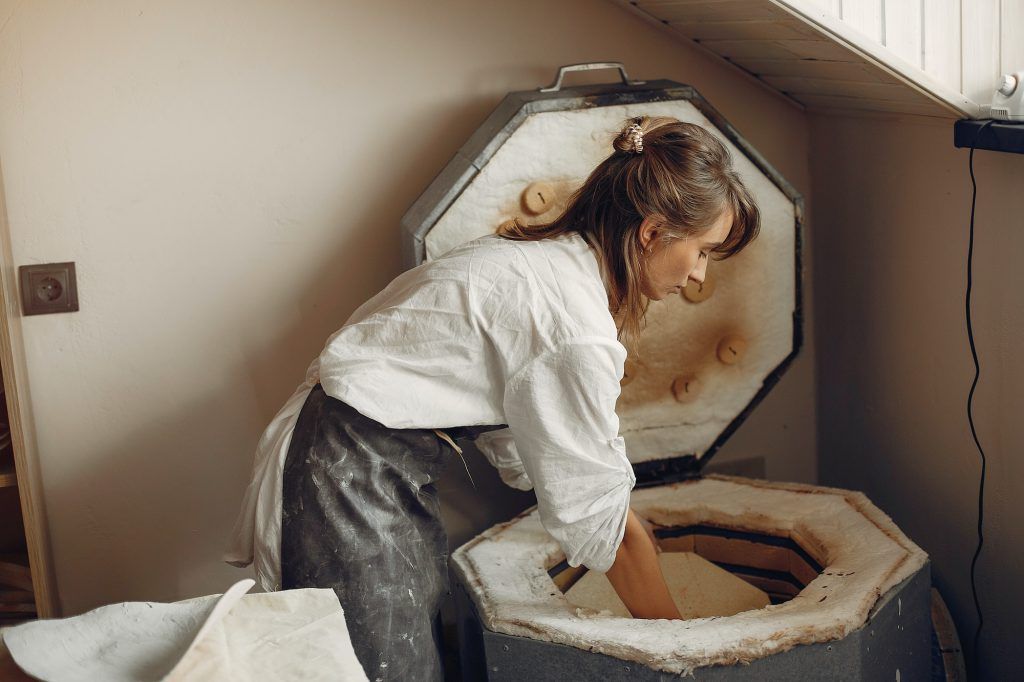
The first decision to make is what type of kiln opening you need: front-opening or top-loading? To choose, you’ll need to consider where you can place the kiln and the type of items you’ll be firing.
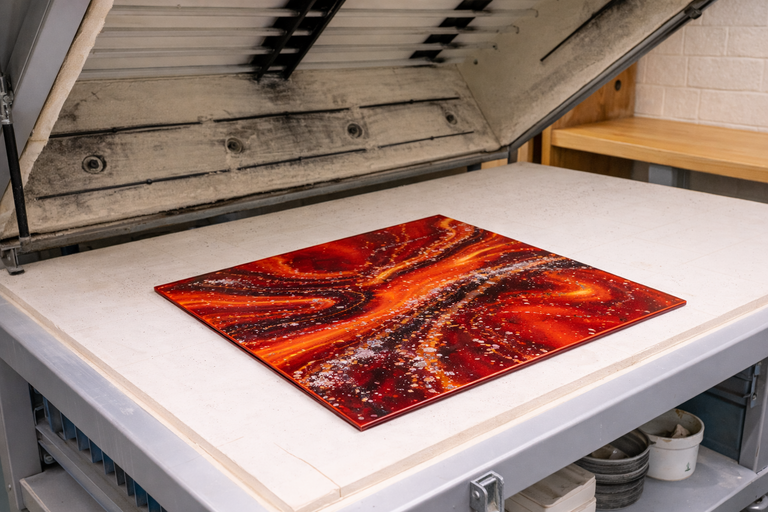
- The front-opening kiln, which is square in shape, can be placed on a table or a stand, making it more convenient for inserting and removing various pieces.
Our recommendations: Hobbyland has many options, for example, check out the Sigma kilns, available in 30 litres, 50 litres, and 70 litres (but also in 100 and 150): they reach a temperature of 1100°C and have an internal fibre lining. Also front-opening, but with a maximum temperature of 1300°C and a brick interior, we recommend the Nabertherm kilns from the N series: N40/E, N70/E, and N100/E.
- The top-loading kiln or top-loading kiln is cylindrical in shape, allowing for more efficient use of space if you are making round objects. It also offers more uniform internal heating, but we will discuss this in more detail when we talk about heating.
What type of insulation do you need?
The second decision concerns the insulating material of your next kiln: bricks or ceramic fibre?
- Ceramic fibre insulation allows for lighter and more economical structures. However, over the years, with intense use, it deteriorates, contracting in size, which you can compensate for with easy patching.
- Refractory bricks have slightly lower insulating power compared to the same thickness of ceramic fibre but last longer. An important point: they are inert materials and do not release particles. When they deteriorate (but only after many years of use), they crumble, and you will need to replace them. Compared to ceramic fibre, they are more fragile, so you need to be careful with impacts.
Where to place the kiln
The ideal position for a pottery kiln is in a room with good ventilation: during firing or glazing, the kiln releases a minimal amount (but really minimal!) of substances. They are not dangerous, but it’s always better to ensure that the room is well-ventilated.
Speaking of ventilation: a ceramic fibre kiln emits smoke and a strong smell during the first firing. Don’t be alarmed: this only happens during the first firing because some organic binders in the fibre burn once a certain temperature is reached. It’s important that during the first firing all windows remain open and the firing program is completed. You can also place it outside, but always ensure it is in a sheltered area and well-sealed when not in use, especially if we are talking about brick kilns, which absorb moisture like sponges. If you have a brick kiln and see that it is damp, always dry it before firing material.
2. Heating
Another crucial aspect of choosing your pottery kiln concerns the working temperature. This choice affects the size and cost even with the same electrical power required. There are two temperature classes: kilns that reach up to 1,100°C and kilns from 1,250° or more. Depending on the materials and processes you need to carry out, you will require different temperatures:
- Third-fire decoration: up to 800°C
- Terracotta and related glazes: between 960° and 1,030° degrees
- Earthenware and related glazes: between 960° and 1,070° degrees
- Stoneware: between 1,050° and 1,150° degrees
- Gres: between 1,200° and 1,300° degrees (this is a material with strong vitrification and impermeability)
- Porcelain: between 1,200° and 1,300° degrees
The uniformity of heating
If you aim to purchase a pottery kiln that has uniformity of heating, we recommend looking for one that allows the placement of heating elements on all internal sides of the kiln, generally found in top-loading kilns, while it is not always possible in more "economical" front-loading kilns.
How does power affect the size of the pottery kiln?
A kiln that reaches a maximum temperature of 1,250°C with 3.2kw of absorbed power cannot exceed 60 litres in volume. Kilns that produce a maximum of 1,100°C can reach up to 80 litres.
One of the most frequently asked questions: I have a 3 Kw contract, will I be able to use the kiln without tripping the power?
If you purchase a kiln that has a power below 3 kw, there are no problems: the important thing is that you do not use other appliances that consume a lot of power (kitchen oven, vacuum cleaner, etc.) at the same time.
Note: considering, for example, a night-time use, with only a medium-power refrigerator running and little else, a 3kw kiln is regularly supported.
How much does a firing cycle cost, in terms of electricity consumption?
We cannot be very precise on this aspect, as it depends on the kiln, the firing program, and energy costs, but to give an indicative idea, a 60-litre kiln consumes between 5 and 10 Euros per firing cycle.
Heating elements and plugs
The heating of electric kilns occurs with electric heating elements, the best being of the Kanthal type. They can have different arrangements inside the kiln: completely encapsulated in insulation, or housed in visible cavities and possibly arranged on ceramic supports. The difference is especially noticeable in case of faults: visible ones can be replaced, while those integrated into the insulation cannot, so you will need to replace the entire firing chamber.
Kilns up to 3.2kw usually come with a 16A Schuko plug or a 16A CEI plug. You will therefore need to ensure that the electrical system has a Schuko wall socket, with wiring to the meter of at least 2.5 mm², separated by a 16A circuit breaker located locally in a small control panel.
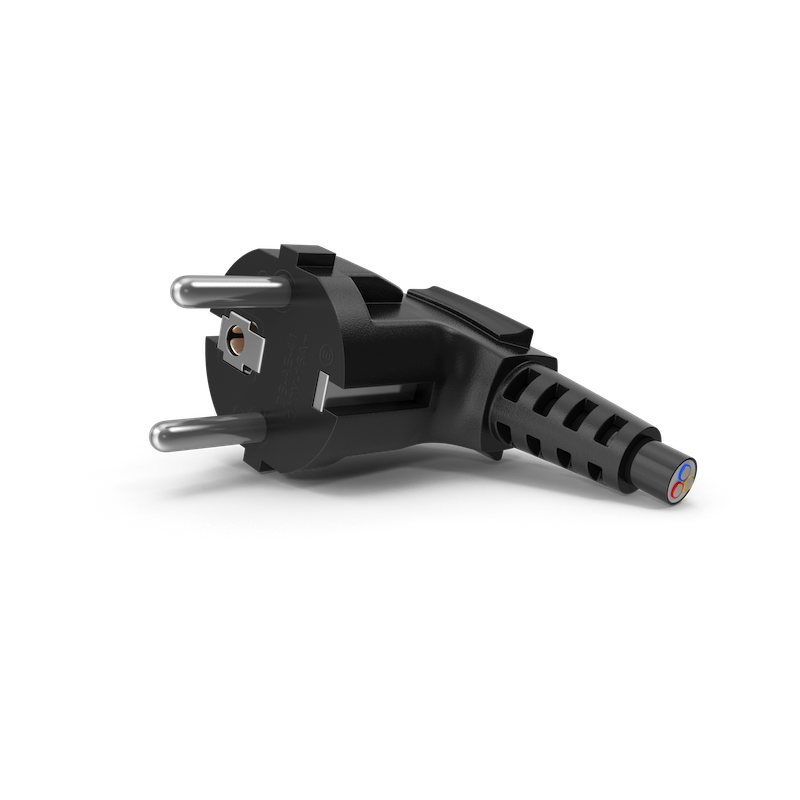
16A Schuko plug
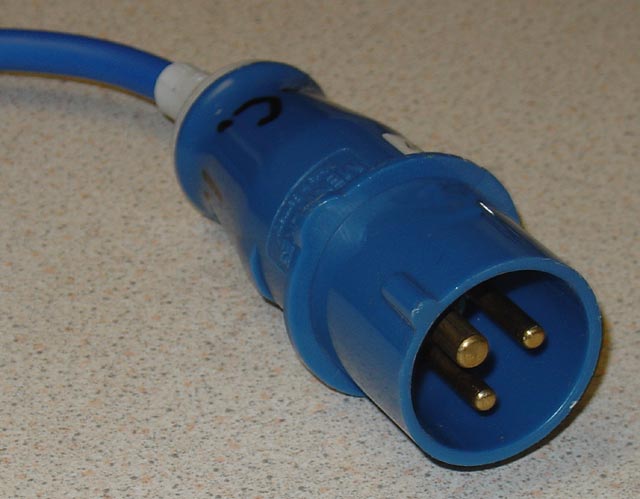
16A CEI plug
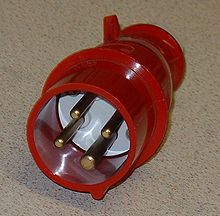
4-pole plug
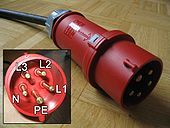
5-pole plug
WARNING! ABSOLUTELY AVOID USING EXTENSIONS OR INADEQUATE ADAPTERS!
Kilns with powers above 3.2kw usually come with three-phase CE plugs, which can be 4 or 5 poles and require the corresponding electrical system. Power meters in homes are usually 3kw, with a tolerance of 10%, so they can provide a maximum of 3,300w. The tolerance is generally a 33% spike for a few minutes. For several years, it has been possible to request power increases of 0.5kw above 3kw. We recommend checking with your supplier.
3. Regulation
The heart of the pottery kiln is the temperature controller: it comes with multiple programs that you can save for different types of firing and materials. The temperature controller manages the control of the heating elements with power elements that can be traditional (contactors) or modern solid-state relays, which have quieter and more precise regulation.
How does the temperature controller work?
The temperature controller modulates the power to follow a hypothetical firing curve: for firing small and medium-sized objects, a simple curve with 4 segments is sufficient.
Our advice: in most cases, a "simple" controller like the B500 from Nabertherm or a UC51 from Sigma kilns is sufficient.
The new B500 controller from Nabertherm features a colour touchscreen and can be connected via Wi-Fi to the My Nabertherm app to monitor the kiln remotely.
If you have large or oversized objects, you will need to consider more complex curves with at least 3-4 segments both in ascent and descent.
4. What else do you need besides the kiln?
In addition to the kiln, we recommend purchasing a kit of refractory shelves: these are high-temperature resistant shelves that allow you to stack items to be fired in multiple layers (just like you would in a kitchen oven).
You can space the shelves apart with refractory posts, which come in various sizes. If the shelf is round, we recommend using at least 3 posts, while if your shelf is square, it’s better to use 4.
Hobbyland has many sizes of shelves available, you can find them in this section, but if you’re unsure which one is right for your kiln contact us and we’ll give you advice.
Another tip: if you have applied glaze to your pieces, keep in mind that during firing it may drip onto the shelf and irreparably damage it. For this reason, we recommend protecting your shelves with a specific protective coating that will create a barrier.
Have you chosen your pottery kiln?
I hope you have a clearer idea now. On Hobbyland you will find a wide selection of all the pottery kilns we have described: front-loading or top-loading, in various sizes, for all types of work, for various temperatures, and in different price ranges. You will also find everything you need to take care of your kiln: ceramic fibres and insulations, sealants, spare parts and bases, shelves and supports.
Inside each product sheet, you will also find many questions from those who have faced the choice of a kiln before you; if you have any doubts, check if there is already an answer, or ask your question and we will respond!