
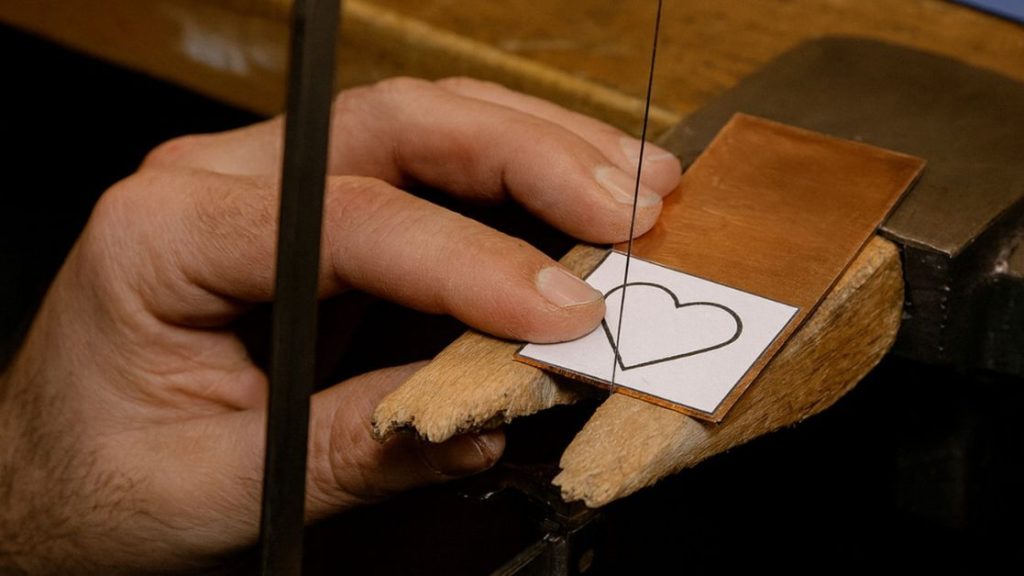
Openwork is one of the fundamental techniques of handcrafted jewelry. The earliest work on gold and copper dates back to ancient Egypt, where it was used to create jewelry and amulets. Since then, this technique has remained central to goldsmithing throughout history, from the Middle Ages to the Renaissance and up to the present day.
It allows you to cut out patterns, shapes and decorations from a simple metal plate, creating unique elements for pendants, earrings, rings or bracelets.
In this guide/tutorial we take you from choosing the metal to finishing the piece.
Let’s get started!
Choice of metal
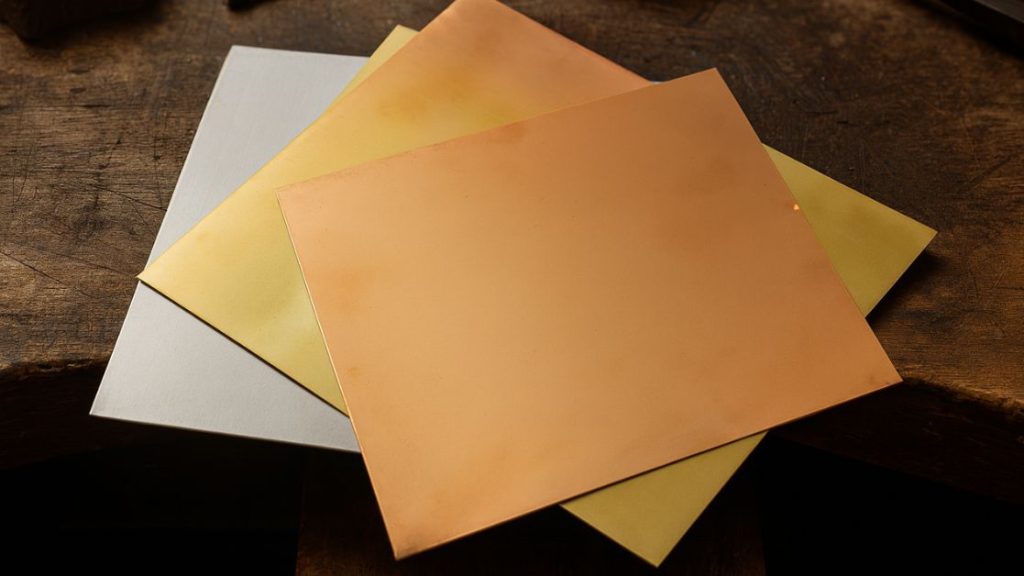
With the fretwork technique, you can work with different soft metals by choosing the blade according to their thickness in order to cut them correctly. To start, we recommend that you choose thin sheets that vary in thickness from 0.3 mm to 1 mm.
Here are the metals you can use:
– ALUMINIUM: the softest and lightest, very easy to pierce and suitable for beginners. Does not contain nickel.
– COPPER: soft, but slightly harder than aluminum. Does not contain nickel.
– BRASS: Variable hardness, but generally harder than copper. Depending on production, it may contain Nickel in small percentage.
– ALPACCA (or argentone): the hardest of the group, similar to brass but less ductile. It contains nickel, and it is the presence of this element that gives nickel silver its silver-white silver-like color.
Always choose the annealed version, which is softer and more malleable.
Drawing and transferring the pattern to the plate
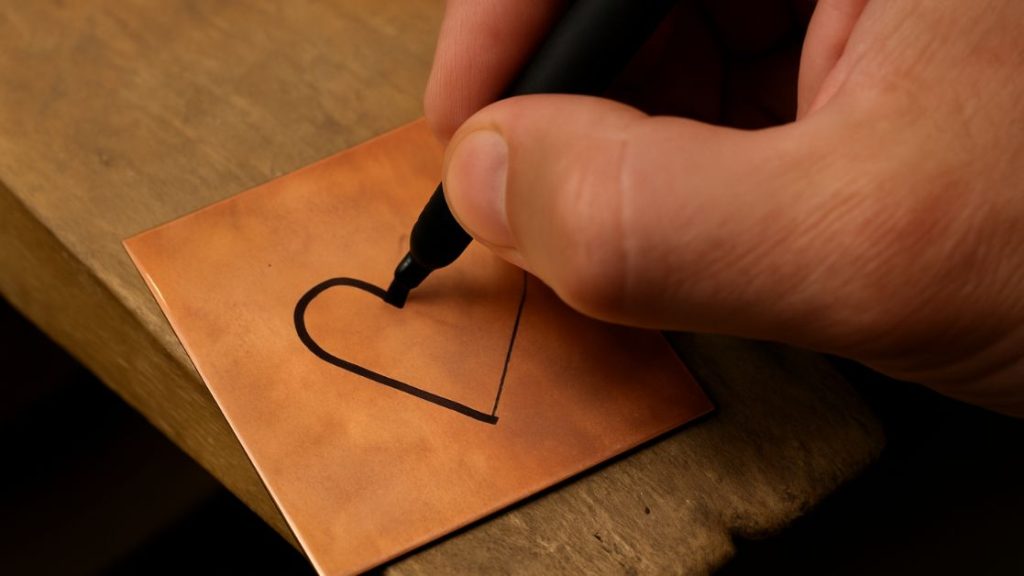
Once the plate has been chosen, the pattern to be pierced is drawn, which can be transferred to the metal in 2 different ways:
1- It can be drawn directly with a fine indelible marker fine or with a pen with a metal tip.
2- Print the design on adhesive paper and apply it to the sheet.
Preparation of the workbench
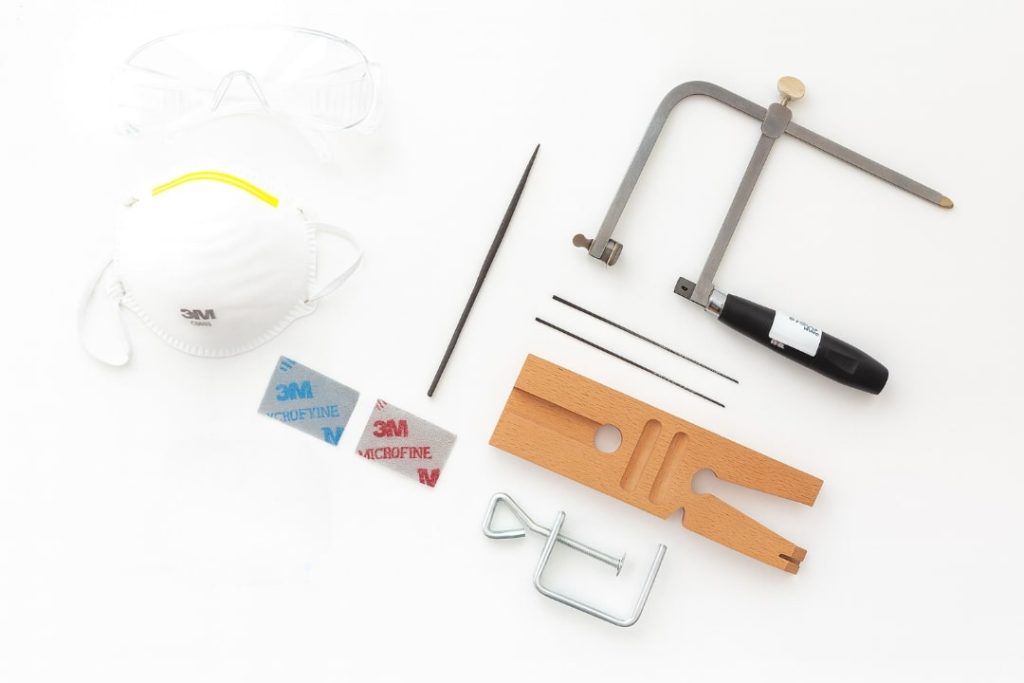
To be able to fretwork comfortably, you will need to prepare your station and have several tools at hand, here are some tips:
- Fretwork board: it facilitates cutting.
Thanks to the V-groove, it supports the sheet while cutting. - Fretwork bow for goldsmiths: you can find several sizes of this product.
Choose the size that best suits your project, considering the distance between the blade and the frame. - Metal fretwork blades: to be mounted on the fretwork bow.
There are several sizes, to be chosen according to the thickness of the sheet. - Beeswax block: used to lubricate the blade before cutting the sheet.
It makes the blade glide more smoothly. - Protective glasses, a mask and an apron
- Metal plate of your choice
- Hand drill for drilling
- Files and Abrasive Papers
Extra tools: - Electric drill + power supply and accessories:
for drilling: Micro drill bits
for polishing: 1 step Brass brushes, Brass discs, Brass cup brushes
2 step Felt wheels, Cylinder felt wheels, Cotton polishing discs - Polishing pastes: Dialux Blue or Yellow
- Metal shear: useful for cutting excess
- Texturing hammers
- Minutery to mount the jewel
Prepare the tools
Attach the fretwork board to your work surface.
Mount the blade on the bow. Unscrew the screws and insert the blade by directing its tips downward. After inserting it screw it back in to secure the blade. On the back of the bow tension the gap so the blade is pulled tight and screw it back on to lock it in place.
Transfer the design.
Wear glasses. a mask and an apron.
Cutting begins
Slide the beeswax block loaf over the sides of the blade. This will help you slide the blade better into the metal.
Roughly cut around the design so that you are more comfortable with precision cutting and do not have too much material to handle. You can do this step either by using a shear or directly by making the cut with the fretwork bow. Hold the bow vertically and proceed with up and down movements. Do not go too fast; make smooth, continuous movements without forcing the blade.
If the blade breaks, don’t worry, for the first few cuts it is normal to waste a few blades to learn how to handle the movement and pressure well.
It’s time to start cutting the finer details of the design. We suggest you start from the side that seems easiest and when you have to curve change direction slowly by moving the piece, always moving with the blade only up and down, without rotating it.
If you have a spot with a very sharp angle, start again from the opposite side and meet the previous cut.
Whenever the blade stops gliding smoothly, run it again over the wax block.
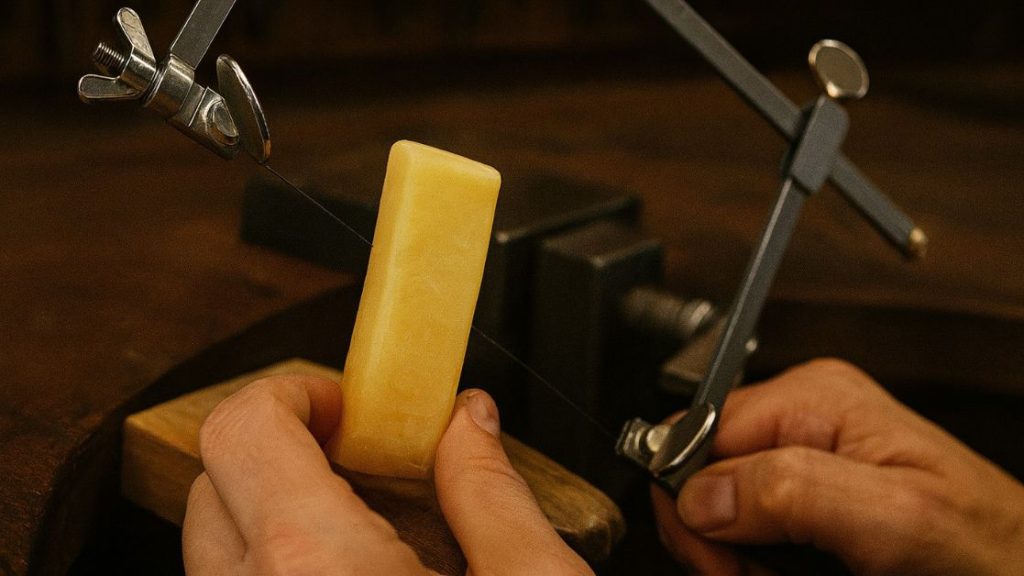
Don’t worry at this stage if the cut doesn’t feel precise and smooth, this aspect will be improved with the final filing.
To pierce an inner part of the design you will first have to use a hand or electric drill to create a hole, we recommend that you lean on a piece of scrap wood so you will be stable. In that hole you will reinsert yourself with the blade by first disassembling it, and then reassembling it on the bow.
Start with simple designs and in no time you will have gotten your base to perfect.
Metal finishing
For this processing there tools for roughing, finishing and polishing.
This details what they are and their uses:
- Microlime Of various shapes for roughing and smoothing. The file has two functions, passed upward it removes material, downward it refines and smooths the surface.
- Abrasive Papers of different grits, 400 to 1200 grits are used. Use in succession to achieve a smooth, glossy surface.
This process requires some patience-the more perfect you want your jewelry, the more time you will have to spend on it-but there are also tools that can speed up the polishing process.
Using an electric drill, with which you can set the speed at which the tools rotate, is certainly a good alternative to files and sandpapers.
And in combination with polishing pastes you will be able to achieve mirror-like surfaces.
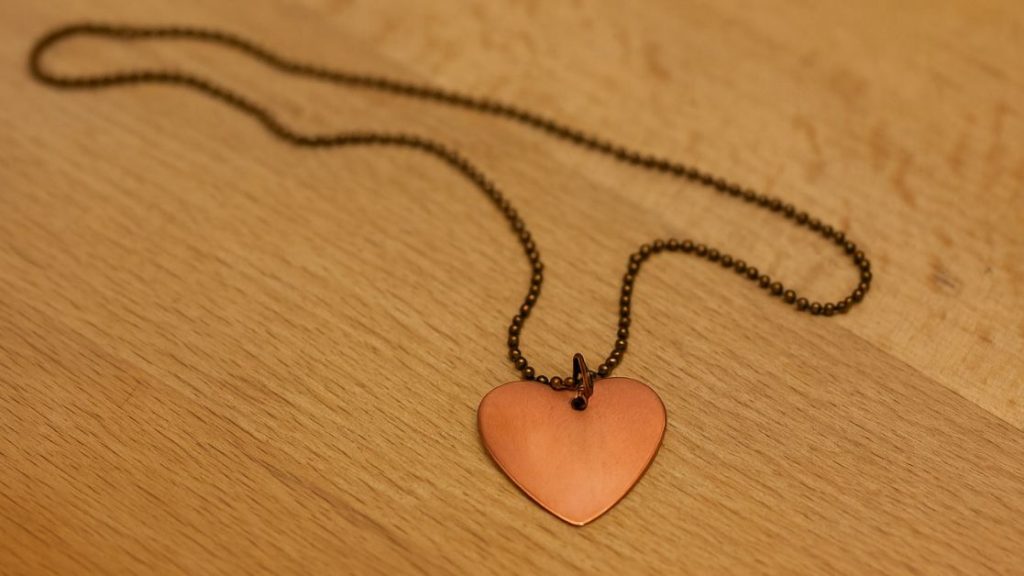
Maintenance and oxidation
This technique is easy to perform and satisfactory results can be obtained from the very first cuts, but one of the most painful aspects of using these metals is oxidation.
There is no way to permanently prevent this patina from forming, as these alloys naturally oxidize when exposed to air and moisture.
However, you can slow down oxidation by applying protective waxes to the surface.
In addition, oxidized metal can always find its luster again after thorough cleaning.
Latest suggestions
To create precise cuts of regular shapes you can make use of a tool called a disc cutter.
You can find it for different shapes such as circles, hearts o squares. By inserting the metal plate and beating the punch with a hammer, you will easily and quickly get the precise shape you choose.
You can then enrich your jewelry by coloring its surface or some details with the two-component cold glazes or with Efcolor powders.
The fretwork technique is an excellent gateway into handcrafted jewelry: simple to learn yet full of creative possibilities.
With a little practice, you can create unique and personal jewelry from a simple sheet of metal.