What are pyrometric cones
Pyrometric cones have been used to monitor ceramic firings for over 100 years. They are useful for determining when a firing is complete, if the kiln has provided sufficient heat, if there has been a temperature difference in the kiln, or if there was a problem during the firing.
They are small indicators made of ceramic material that measure the entire heat-work and not just the temperature. This means they do not simply evaluate how many degrees your kiln reaches, but how temperature and firing time work together on the ceramic.
- The cones detect the combined effect of temperature + firing duration.
- They bend when the right maturation level is reached, when the tip of the cone bends completely.
- They are more reliable than just a thermometer because the thermocouple does not measure the actual heat-work of the entire kiln area.
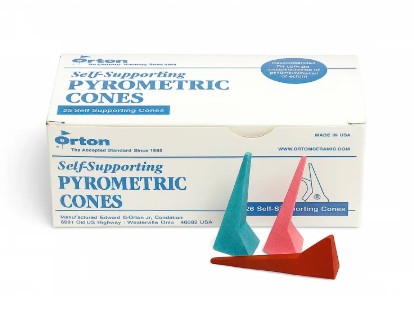
The self-supporting cones you find at Hobbyland are even easier to use: they have a built-in base that keeps them tilted at the ideal angle without the need for external supports.
Why use them in ceramic firing
Orton cones are extremely useful for:
- check that your kiln really reaches the expected maturation,
- understand if there are hotter or cooler areas,
- calibrate new kilns or those that have lost accuracy,
- achieve more stable and repeatable glazes and clays.
Especially recommended for those working with:
- low-temperature glazes (900–1050 °C),
- stoneware and porcelain (1200–1280 °C),
- artistic ceramics and productions sensitive to heat variations.
Selection and positioning of pyrometric cones
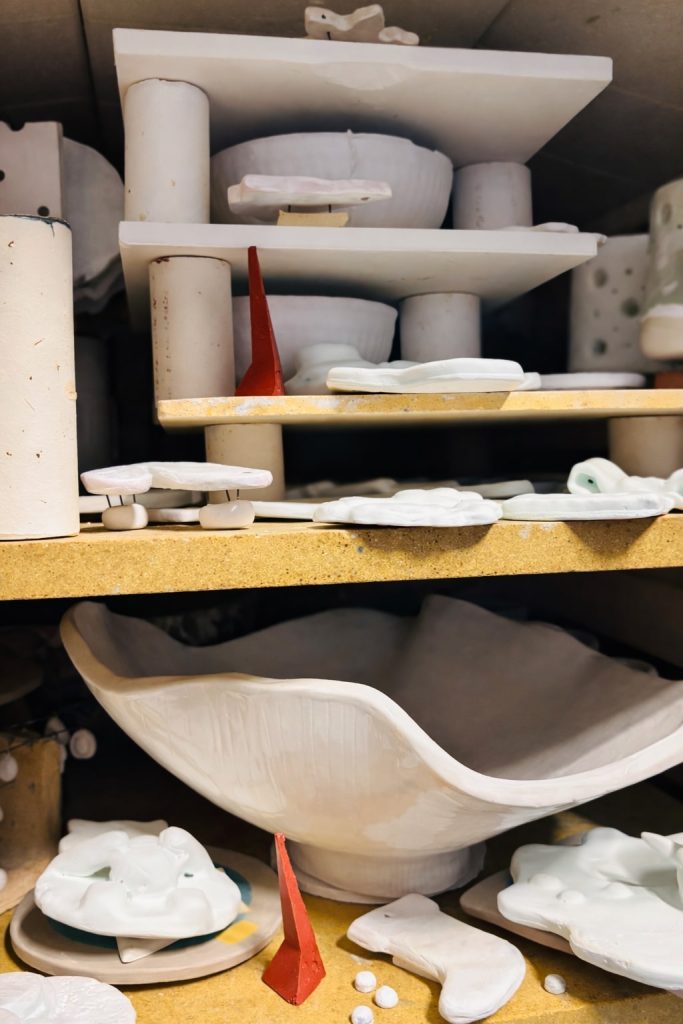
The choice of the cone number to use mainly depends on the final firing temperature, the heating rate in the last 100°C, and any holding times.
This simplified table, which lists temperature ranges and firing types, will help you in choosing the cones to use:
| Cone Number | Temperature Range (°C) | Firing Type |
| 019 | 656 ~ 695°C | LOW TEMPERATURE DECORATIONS / THIRD FIRING |
| 018 | 686 ~ 734°C | LOW TEMPERATURE DECORATIONS / THIRD FIRING |
| 017 | 705 ~ 763°C | LOW TEMPERATURE DECORATIONS / THIRD FIRING |
| 09 | 907 ~ 930°C | GLAZES / CRYSTALLINES |
| 08 | 922 ~ 956°C | GLAZES / CRYSTALLINES |
| 07 | 962 ~ 987°C | GLAZES / CRYSTALLINES / RED EARTH BISCUIT |
| 06 | 981 ~ 1013°C | GLAZES / CRYSTALLINE / RED AND WHITE STONEWARE |
| 05 1/2 | 1004 ~ 1025°C | WHITE STONEWARE |
| 05 | 1021 ~ 1044°C | WHITE STONEWARE |
| 04 | 1046 ~ 1077°C | WHITE STONEWARE |
| 03 | 1071 ~ 1104°C | GLAZES |
| 02 | 1078 ~ 1122°C | GLAZES |
| 3 | 1115 ~ 1170°C | HIGH TEMPERATURE GLAZES |
| 4 | 1141 ~ 1183°C | STONEWARE / HIGH TEMPERATURE GLAZES |
| 5 | 1159 ~ 1207°C | STONEWARE / HIGH TEMPERATURE GLAZES |
| 5 1/2 | 1167 ~ 1225°C | STONEWARE / HIGH TEMPERATURE GLAZES |
| 6 | 1185 ~ 1243°C | STONEWARE / HIGH TEMPERATURE GLAZES |
| 7 | 1201 ~ 1257°C | STONEWARE / HIGH TEMPERATURE GLAZES |
| 8 | 1211 ~ 1271°C | STONEWARE / PORCELAIN / HIGH TEMPERATURE GLAZES |
| 9 | 1224 ~ 1280°C | STONEWARE / PORCELAIN / HIGH TEMPERATURE GLAZES |
| 10 | 1251 ~ 1305°C | STONEWARE / PORCELAIN / HIGH TEMPERATURE GLAZES |
| 11 | 1272 ~ 1315°C | STONEWARE / PORCELAIN / HIGH TEMPERATURE GLAZES |
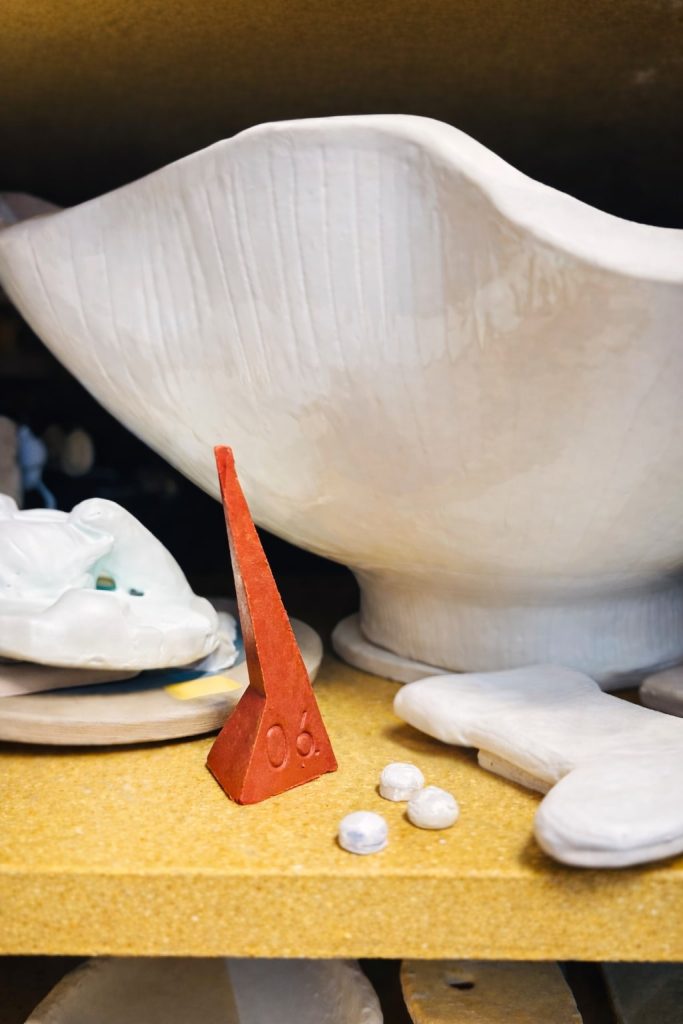
To achieve an accurate reading, you need to position the cones strategically and on stable shelves, avoiding areas directly exposed to the heating elements.
We recommend using at least three cones to test the kiln:
- one “under” cone (e.g. no.04, lower temperature than your target)
- the target cone (e.g. no.03)
- a “higher” cone (e.g. no.02, higher temperature than your target)
This way you can understand: - the first when it starts to bend (the kiln is heating up)
- the second when it is perfect (it has reached the firing you wanted)
- the third if it has overheated too much (if it bends too early or too much)
Orton recommends repeating this trio in different areas of the kiln (top-center-bottom or left-center-right) to “map” the thermal distribution.
What happens during firing
The cone responds mainly in the final phase of firing, approximately in the last 100°C.
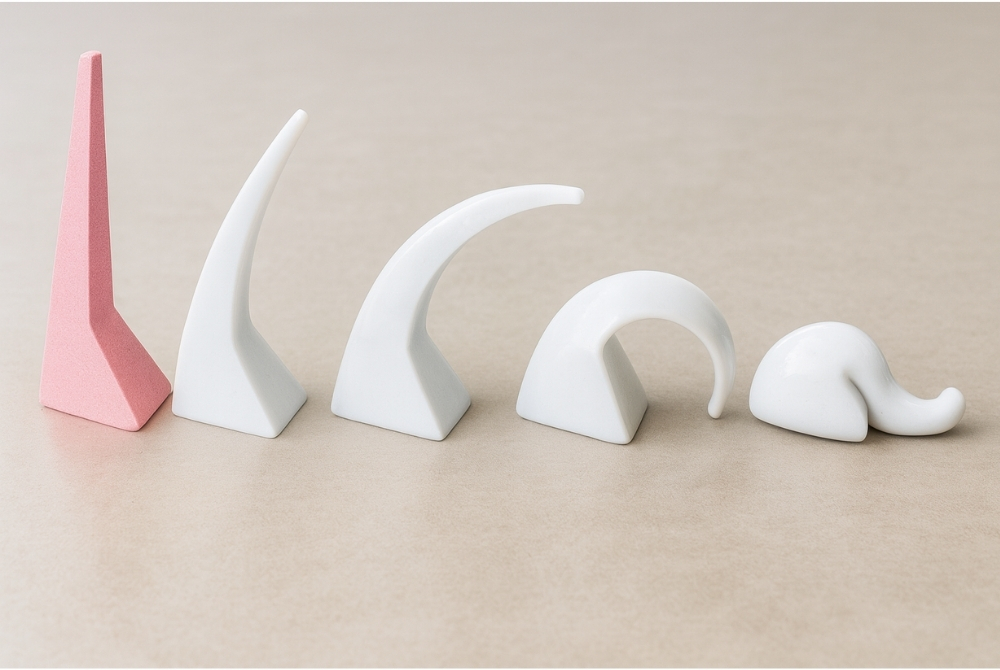
If the firing is too short → the cone remains too vertical
If correct → the cone “caresses” the base with the tip
If excessive → the cone completely falls or melts
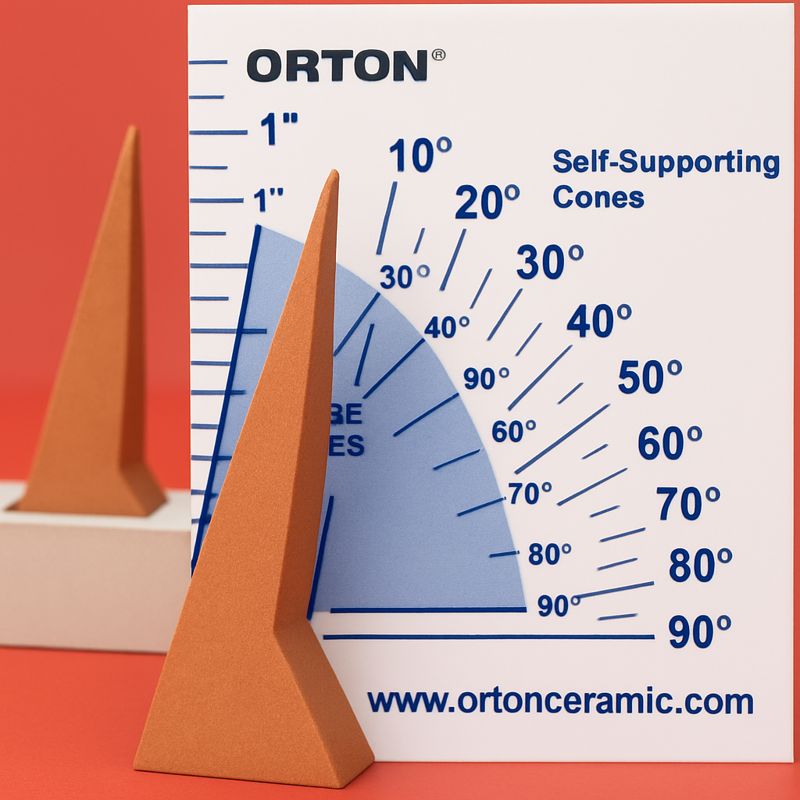
To calculate the temperature, you need to know the heating rate of the kiln and the curvature angle of the cone. The curvature angle can be determined using the Orton measuring jig. Then, based on the heating rate and the curvature angle, you can calculate the equivalent temperature on the Orton cone chart.
How to read the cone results
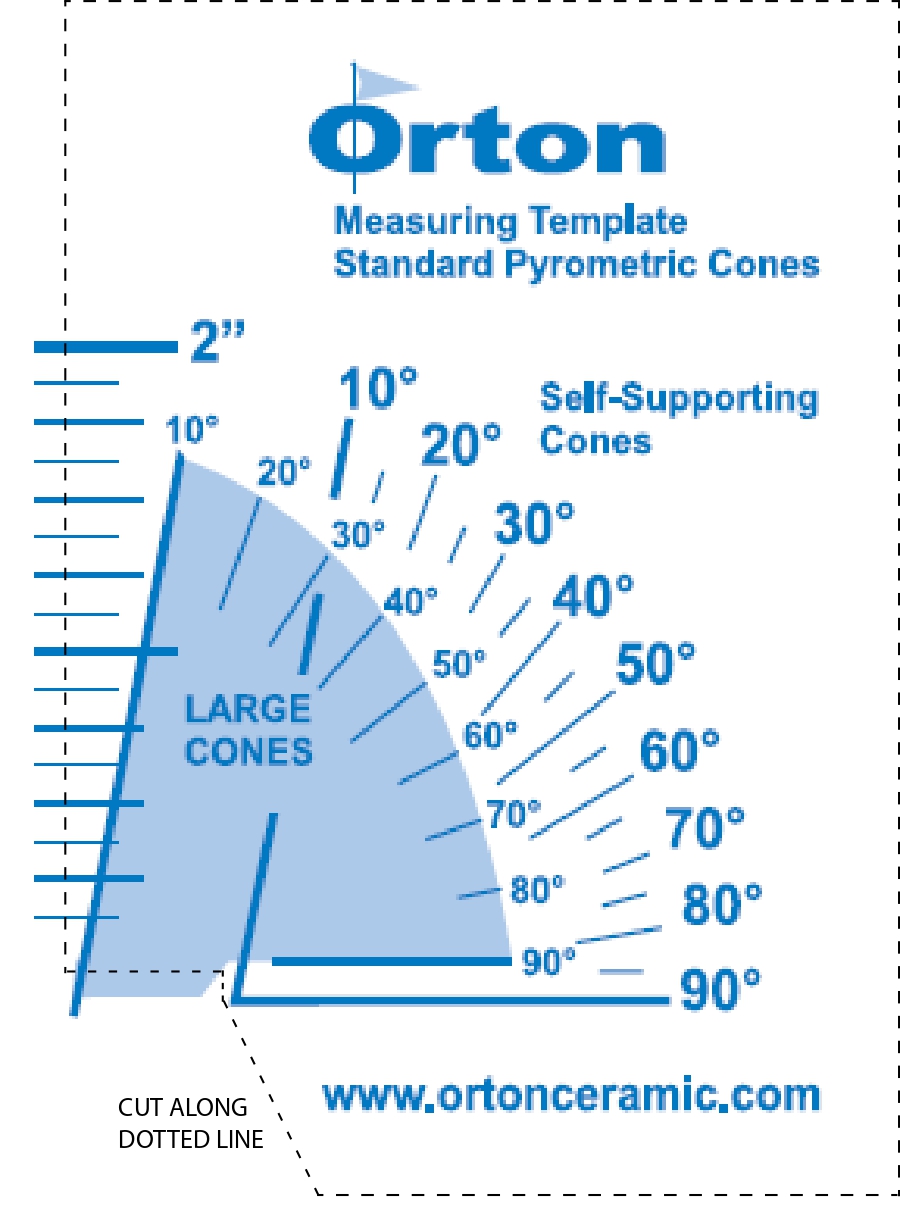
There are two methods to “measure” a cone. The first method requires the use of the Orton measuring template. The Orton measuring template is a board used to measure the bending angle of the cones. The board will indicate bending angles ranging from 10 to 90 degrees. The fired cone is placed next to the board, and the position of the tip of the cone indicates a bending angle. A cone bent at 90 degrees is considered properly fired.
The second method used to measure the cones is the “clock method.” This method requires the operator to translate the position of the tip of the cone onto the face of a clock. The 1 o’clock position is for cones that have not bent at all, while the 6 o’clock position is for a cone whose tip touches the shelf. A cone in the 5 o’clock or 6 o’clock position is considered properly fired.
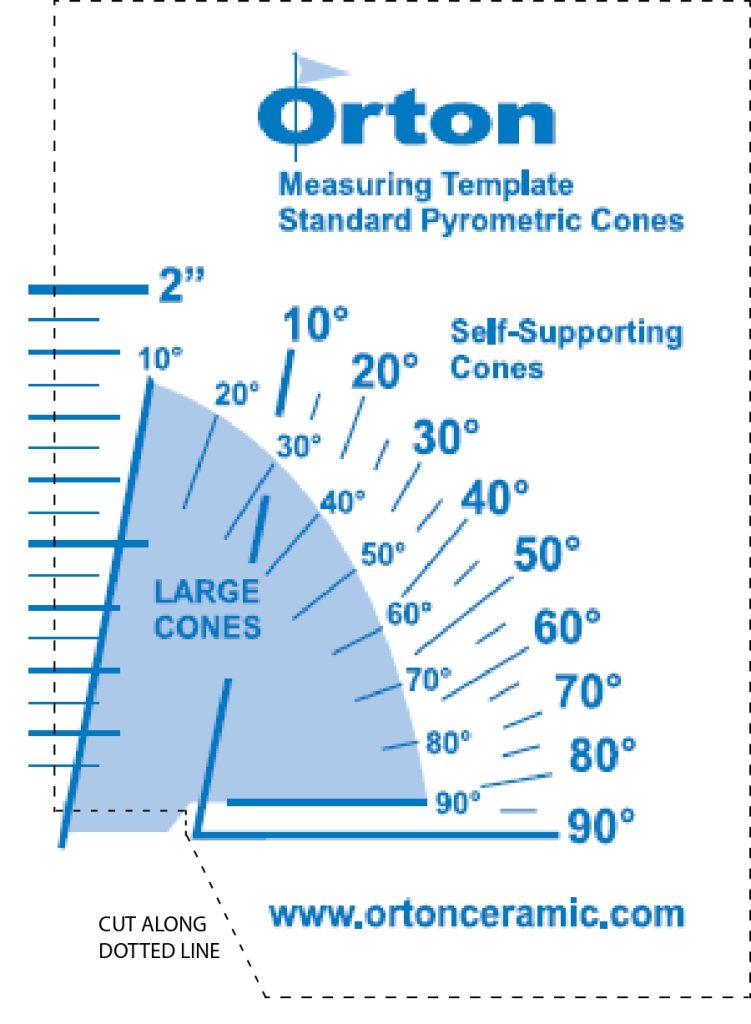
Orton measuring template
You can download and print this template to use when reading the results of your pyrometric cones.
Before proceeding to print, resize the drawing to 2″=5.08 cm to have the template at the correct size.
FAQ
- HOW TO USE CONES?
Self-supporting cones are used to measure the uniformity of temperature and/or whether sufficient thermal processing has been carried out to mature the artifact. The cones indicate if the artifact has received an adequate amount of thermal processing for the proper maturation of the clay or glaze. A properly fired cone will bend with the tip almost touching the shelf. After firing in the kiln, a simple glance at the cone can indicate whether the firing was successful.
The only actual measurement of thermal processing is obtained from a self-supporting cone placed on the shelf next to the artifact. - WHAT DO THE TERMS HEATING RATE AND HOLDING MEAN?
Heating rate refers to the increase in temperature of the kiln for each hour of firing. If a kiln takes three hours to reach a temperature of 460°C, its heating rate will be 150°C per hour. It is important to know the heating rate as it determines the temperature at which a cone will deform.
The term “holding” means that the kiln is maintained at a specific temperature for a period of time. This practice is carried out to help equalize the temperature throughout the kiln or to produce the desired effect in the firing. - I’VE NEVER USED CONES BEFORE, WHICH CONE SHOULD I USE?
Most clay or glaze manufacturers indicate the cone value for firing on the product label. They have already determined, through testing, which cone will deform and bend when the glaze or clay reaches maturation. An example could be a stoneware glaze with a maturation cone of 6. - I HAVE VERY OLD CONES, CAN I STILL USE THEM?
Yes, cones do not have an expiration date. If they are in good condition, have been stored in a dry place, and do not break easily, they can still be used. Orton engineers regularly test fire cones made over 50 years ago, without finding any variation in firing results. - IF THEY HAVEN’T BENT CAN I REUSE THEM?
No, they cannot be reused. They have already “reacted” to the firing, even if they haven’t bent, and therefore cannot be used for a new cycle.