
Making candles at home is a very satisfying activity. It allows you to test your manual skills but at the same time apply your flair and creativity into something solid, visible, fragrant, and… bright.
It is quick to say candles, but there are so many types of candles, we must first understand what kind of candle we are talking about, because each one requires different materials, processing, and therefore also different final effects.
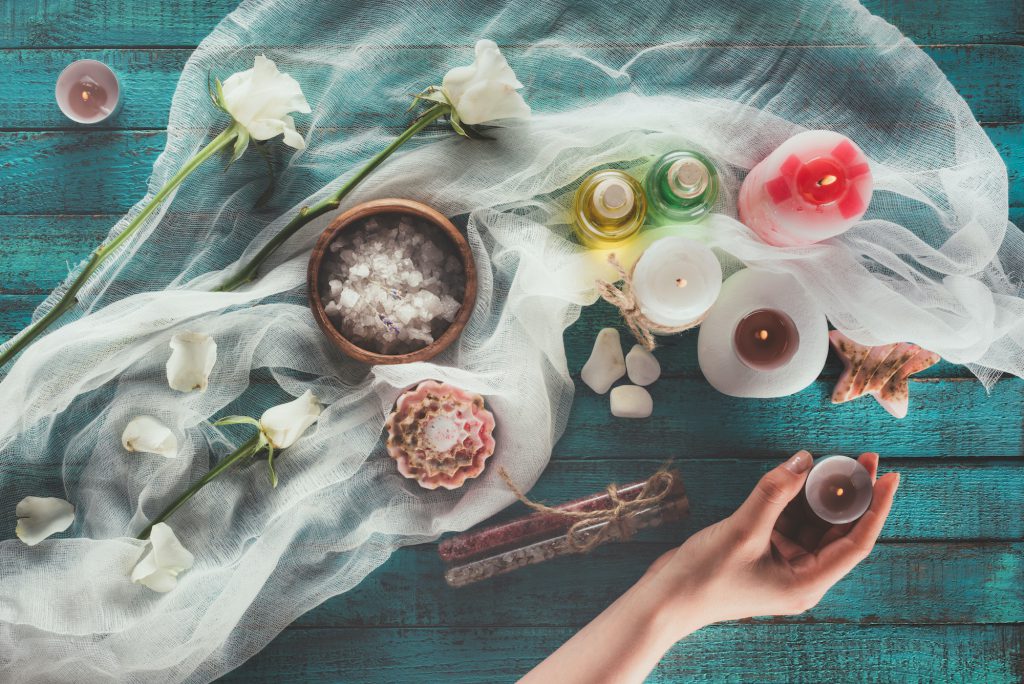
In this post we look at what kinds of candles we can make at home and what kinds of wax we can use for each type.
Then we will see, in another post, the materials we need to make them and how to organize the work space, and finally the various procedures for making our own candles at home.
So today we are talking about:
- The types of candles you can make at home
The u0022free standingu0022 freestanding candles.
The tealight candles
The carved (dipped) candles
Candles in containers
Tarts (melting wax)
The tapered candles (dipping)
Summary table which wax for which candle - The types of wax for candles
Kerosene
Stearina
Premixed wax beads
Soy wax
Palm Wax
Beeswax
Moldable wax
Wax sheets
Gel wax - What wax do I choose for making mold candles?
- What wax do I choose for containers and modeling?
- Is there a transparent mold wax?
- What are the ideal temperatures for wax casting?
The types of candles you can make at home
Do you already know what kind of candles you would like to make? Here are the most common types:
The freestanding candles.
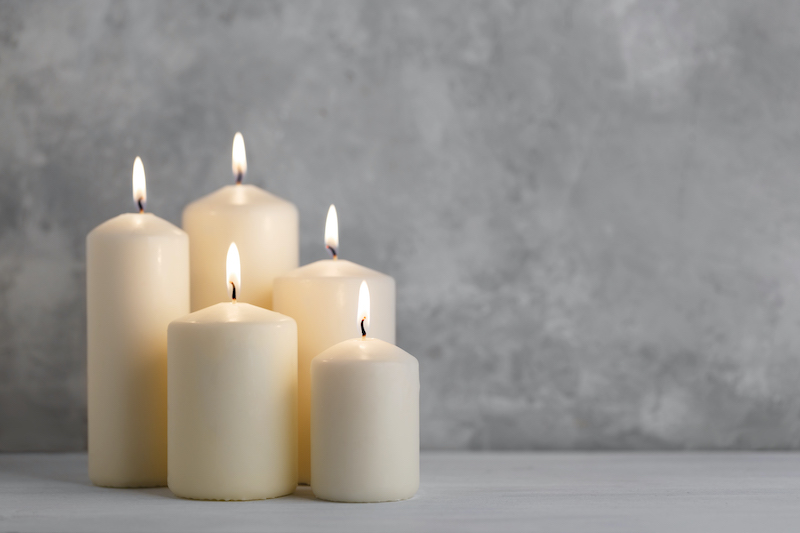
Free standing means, simply, that they stand on their own. So you won’t need any container or support. They are usually made with molds, in which you can melt paraffin, premixed wax beads, stearin, beeswax or palm wax (for molds).
The tealight candles
Among container candles the most popular are the tealights, in small aluminum or plastic containers. You can make them with any kind of wax, especially paraffin, mixture of paraffin and stearin, soy, palm and beeswax.
The carved candles (dipping)
They are particularly decorative candles, and consist of multiple layers of colored wax: carving the surface reveals the various layers, creating a very artistic and striking effect.


Candles in containers
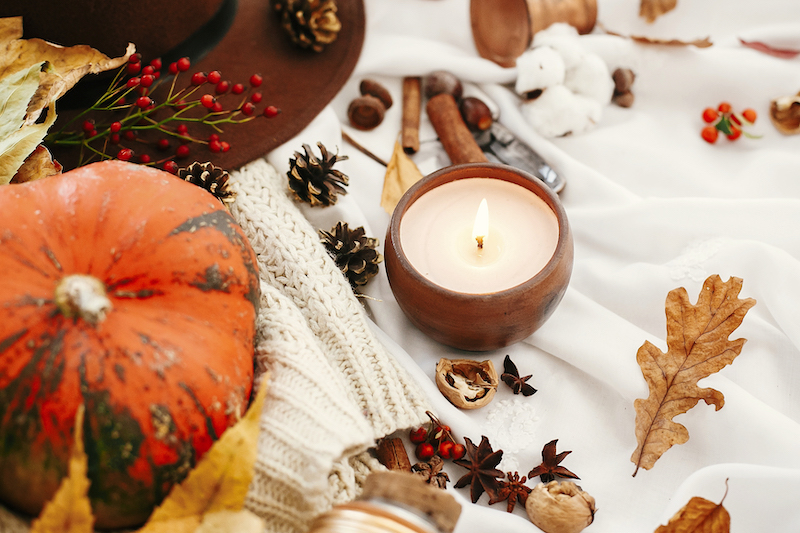
You can make candles inside containers made of glass, metal, plastic or other materials, with or without cap. You can also use different types of wax for these candles: paraffin wax, premixed wax beads, stearin, soy wax, gel wax, beeswax or palm wax (for containers).
Le tarts (melting wax)
Tarts are wax tablets for melting in potpourri or wax burners for melting wax. The most commonly used waxes for making tarts are kerosene wax, soy wax, and natural wax blend.
The taper (dip) candles
These are long, narrow candles, to make a point, the kind normally used in candelabra. To make them, the wick is dipped several times in melted wax. The most commonly used waxes for these candles are paraffin, premixed wax beads, and beeswax.
A table to get a good understanding of the types of wax we can use to make various types of candles at home
| Wax type | Self-supporting candles | Candles in containers | Dipping candles | Tarts |
|---|---|---|---|---|
| Kerosene | ✅ | ✅ | ✅ | ✅ |
| Hard paraffin | ✅ | ✅ | ✅ | ✅ |
| Premixed wax beads | ✅ | ✅ | ✅ | ✅ |
| Ecosoya PB | ✅ | ✅ | ||
| Ecosoya CB135 | ✅ | ✅ | ||
| Palm wax for molds | ✅ | |||
| Palm wax for containers | ✅ | ✅ | ||
| Pure stearin | ✅ | ✅ | ||
| Beeswax | ✅ | ✅ | ✅ | |
| Blend of natural waxes | ✅ | ✅ | ||
| Gel wax | ✅ |
The types of wax for candles
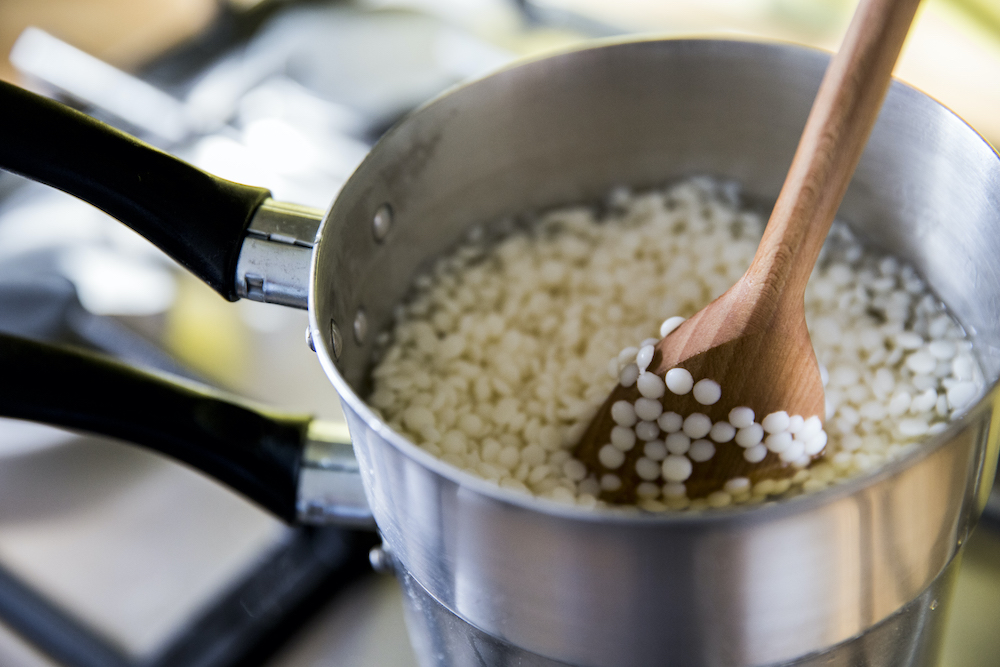
There are many types of waxes on the market, and we have a nice selection of them, too. Each has specific characteristics that make it more suitable for one type of candle than others. Let’s look at the most commonly used waxes and their characteristics.
Kerosene
Paraffin is the most widely used wax for making candles at home, low in cost and high in yield: it is good for almost any type of candle. You can find it in two versions: standard (melting temperature 52-54°C) or hard (melting temperature 56-58°C).
For container candles, we recommend standard paraffin, while for freestanding candles you’re better off using hard paraffin.
You can add additives to the paraffin, such as stearin or vybar, which improve its burning, opacity, and extraction from the molds.
Stearina
Stearin is a white flaky substance that is obtained from palm oil. You can use it as an additive in paraffin (usually at a percentage of 10%) to make it burn better and make it easier to extract from the mold. If you use higher percentages of stearin, the paraffin will become whiter and more opaque but will be more difficult to extract from the molds.
You can also use stearin in pure form to make candles with a “crystallized” appearance; however, extraction from the mold will be more difficult than for other waxes. Once the stearin has been poured and cooled, you can immerse the mold in hot water (70°C) for a few seconds while holding the mouth of the mold upward. The stearin layer in contact with the mold will melt slightly and you can pull the candle out by pulling the wick. This operation, with all other waxes, would ruin the surface of the candle, but not with pure stearin, because it is much harder than other waxes.
Premixed wax beads
Wax beads are a ready-made mixture of paraffin and stearin, and are perfect if you want a ready-to-use blend-you’ll only need to add fragrance and dyes. You can also use them to make freestanding, container, dip and tart candles at home.
Soy wax
Soy wax is a 100% natural wax made from hydrogenated soybean oil.
You can use it to make container candles(Ecosoya CB-135) or freestanding candles(Ecosoya Pillar Blend).
Soy wax has substantial differences from paraffin wax:
- It is a 100% natural wax.
- It has a pastel yellow coloring, perfect for making warm autumn coloring, to which you can add atmospheric scents.
- To get other colors, you will have to use many more colors or pigments instead.
- On the other hand, it requires no other additives besides dyes and fragrances.
- It has a lower scent release: therefore it will always be less fragrant than a paraffin candle, for example.
Palm Wax
Palm wax is a 100% natural wax made using hydrogenated palm oil. It allows you to create candles with crystallized surfaces; this effect can vary depending on the temperature you use for pouring. One advantage of palm wax is that it has a good scent release and you can easily color it with powder pigments or Liquicer liquid dyes. You can find it in two versions, one best for containers and tarts and the other for use with molds.
Beeswax
Beeswax is a 100% natural wax. You can use it for freestanding, container or dipping candles. There is also in ready-to-roll sheets.
Moldable wax
How to become a child again: it is wax in blocks form, it softens with the heat of your hands and you can shape it like clay. You can use a needle or a knitting needle to insert the wick.
Wax sheets
This formulation also has a playful component that makes it popular: they are sheets of wax that you can cut out or roll up, and you can use them for exterior candle decoration.
Gel wax
Gel wax is transparent with a gel-like consistency. It is not actually a real wax because it is made by mixing mineral oil with a special polymer. Since it is transparent, to enhance it best, we recommend that you pour it into transparent containers. To make the candle even more of an effect, you can place any object in the container-just make sure it’s not flammable!
What wax do I choose for making mold candles?
To create mold candles at home, the most suitable waxes are pure paraffin, premixed wax beads, and Ecosoya PB wax. Let’s look at the differences.
Pure paraffin tends to be more transparent when pouring in the mold at a higher temperature. For this reason, depending on the temperature used for pouring, colors may vary from opaque to brilliant.
Premixed wax beads tend to be whiter due to the percentage of stearin contained within. In addition, stearin provides the candle with great stability.
Pure stearin makes it possible to obtain “crystallized” candles; however, extraction from the mold will be more difficult than with other waxes. A little trick: once you have poured and cooled the stearin in the mold, you can immerse it in hot water (70°C) for a few seconds, holding the mouth of the mold upward. The stearin layer in contact with the mold will melt slightly, and you can pull the candle out by pulling the wick. The same operation with all other waxes would ruin the surface of the candle, but not with pure stearin, because it is much harder than other waxes.
Ecosoya Pillar Blend soy wax is the only soy wax suitable for creating candles in the mold. It should be poured into the mold between 68°C and 79°C.
Palm wax is ideal for use for candles in a mold. If you use metal mold, we recommend preheating it with a hot air gun.
Beeswax can also be used in molds, but it will have limitations due to its consistency, which makes it very difficult to pull out of the molds. For this reason we recommend that you use it only in conical plastic molds in two sections (e.g., balls, eggs ) or in very flexible silicone molds. After you pour the wax into the mold you can put the mold in the refrigerator (not the freezer!), the wax will come off the walls of the mold more easily.
What wax do I choose for containers and modeling?
EcoSoya CB-135 100% vegetable so y wax is specifically for making container candles; it also has an excellent natural scent, which bonds perfectly with fragrances. You will get very beautiful candles that will withstand any kind of climate.
Natural palm wax, supplied in grains, allows you to achieve very special effects
Specifically for pouring into containers, it adheres perfectly to the walls of the substrate into which it is poured. The optimum melting temperature is between 55° and 57°C.
The characteristic of gel wax is its transparency, so it looks its best in transparent glasses, jars or containers. You can also create special effects by inserting small objects into the wax. You can also color it by melting a small amount of Liquicer or stick pigments while melting. To achieve an effect without bubbling or tarnishing, you must bring it to a temperature above 70°, avoiding melting it in a water bath. Warning: never leave it unattended on the stove.
Modeling wax is a soft wax with a medium melting point (58°C). You can easily shape it with the heat of your hands and pour it into delicate molds, such as glass and ceramics. It is also good for coating styrofoam subjects for decoration.
Is there a transparent mold wax?
No, there is not. To get the most transparency you can use pure paraffin, in fact it is also used to make lanterns: just join 4 sheets of wax together and place one or more tealights in the center.
Pure paraffin is also used to finish and protect decorated candles. In this case it should be heated to 90° C and then quickly dipped into the candle to form a protective veil.
What are the best temperatures for wax pouring?
The answer depends on the type of candle and material you are using to make it:
Dipping candles
With 60/40 beeswax: 70-73°C.
With 100% pure beeswax: about 75°C.
With pure paraffin, mixture of paraffin and stearin or wax beads: 70-73°C.
Final dipping of decorated or colored candles in pure paraffin: 90°C.
Mold candles
You must always take into consideration the actual heat resistance of the mold. If the mold can withstand up to 80°C, you should pour the wax at this temperature. If the mold can withstand higher temperatures, the optimum pouring temperature is 90°C.
For silicone molds, although they are resistant to higher temperatures, we recommend a pouring temperature of 80°C.
To measure the temperature, use a special thermometer that has a range of 20° to 110° C. You will need to hold the thermometer suspended in the wax until you reach the desired temperature. At this point you can remove the thermometer, as long as it is hot you can easily wipe it off with kitchen paper to remove wax residue.
We will soon talk about the other materials and tools we need to make candles at home: casting containers, wicks, pigments and molds. Then we will be ready to see the whole porcedure!